
Pancreatic Function and Metabolic Control: A Clinical Case Integrating Exosomes
Apr 23, 2026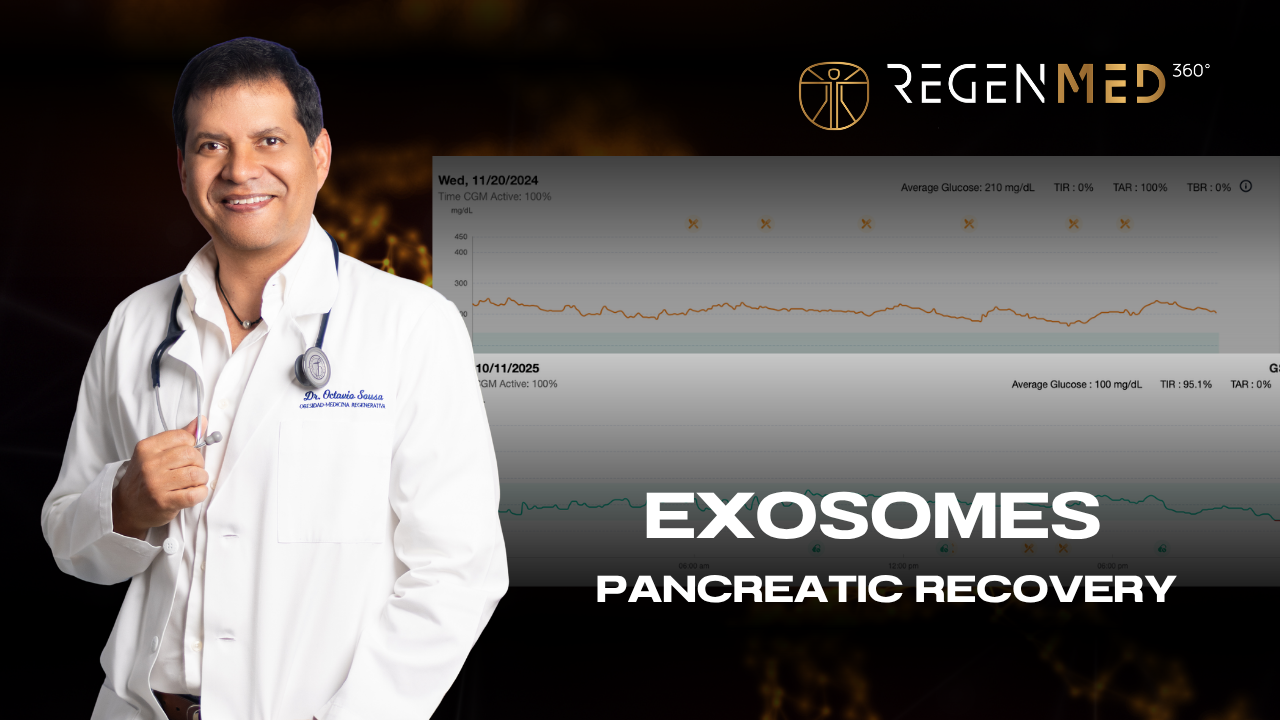
In my medical practice, one of the most critical scenarios I encounter is when a patient is approaching the need for insulin therapy.
These are patients with persistently elevated glucose levels and clear signs of metabolic strain, where the pancreas is no longer responding efficiently.
This was the case of a patient evaluated at RegenMed360 in Panama.
Initial clinical context
The patient presented with:
- Average glucose levels around 210 mg/dL
- Persistent glycemic instability
- Signs of pancreatic stress
- A clinical recommendation to initiate insulin
From a metabolic perspective, this reflects a condition where:
- Insulin response is impaired
- The pancreas is under continuous demand
- There is an underlying inflammatory environment
The approach: treating the environment, not just the symptom
Rather than focusing solely on glucose levels, we approached the case from a broader perspective: creating a controlled metabolic environment
This approach, applied at RegenMed360, aims to address:
- Metabolic function
- Inflammation
- Cellular signaling
- Energy efficiency
Within this context, intravenous exosomes were integrated as part of the medical strategy.
Why exosomes?
Exosomes are extracellular vesicles that function as cellular messengers.
They transport biological information between cells, including:
- Proteins
- Lipids
- Genetic material
From a clinical standpoint, they may be considered within strategies aimed at:
- Supporting cellular communication
- Modulating biological processes
- Optimizing cellular function
Integration with a controlled metabolic environment
It is important to emphasize that exosomes were not used as a standalone intervention.
They were integrated into a structured protocol that included:
- Metabolic control
- Continuous glucose monitoring
- Regulation of the physiological environment
- Ongoing clinical supervision
The outcome is not attributed to a single intervention, but to the combined medical approach.
Observed evolution
During follow-up, a favorable clinical evolution was observed, including:
- Improved glycemic stability
- Reduced glucose variability
- Increased energy levels
- A more balanced metabolic profile
Continuous monitoring data showed a transition from a dysregulated pattern to a more stable metabolic response.
Clinical interpretation
From a medical perspective, this type of evolution may suggest:
- Improved metabolic regulation
- Reduced pancreatic stress
- Better cellular signaling
However, it is essential to emphasize that each patient responds differently, and outcomes must always be interpreted within the individual clinical context.
Beyond glucose levels
One of the most common mistakes is focusing only on glucose values.
In my experience, meaningful change occurs when we:
Optimize the metabolic environment
Reduce inflammation
Support cellular function
A different medical perspective
This case reflects a principle I apply consistently: do not treat the symptom alone—understand the underlying cause
At RegenMed360, we integrate:
- Metabolic medicine
- Regenerative medicine
- Continuous monitoring technologies
to make decisions based on real patient data.
Could this approach be relevant for you?
If you are dealing with:
- Diabetes
- Insulin resistance
- Excess weight
- Chronic fatigue
- Persistent inflammation
it is important to evaluate your case from a broader metabolic perspective.
Each patient requires an individualized approach.
Final reflection
This type of case is not about “quick fixes,” but about understanding how the body functions and creating the right conditions for it to respond.
That has always been my approach as a physician.
Do you want to improve your metabolism and cellular health?
At RegenMed360, we perform comprehensive evaluations to understand how your metabolism is functioning and design a personalized plan to optimize your health.
Our approach integrates metabolic medicine and regenerative medicine to help you restore your body’s natural balance.
Would you like to better understand how your body works?
Dr. Octavio Sousa explains it in the video below.
We respect your privacy. Your information will only be used to provide you with relevant medical information.
